2021
The website was developed specifically for the project.
Die Website wurde eigens für das Projekt entwickelt.
www.memore.chiharukoda.com (in germen / auf Deutsch)
Research Background
How is space generated?
How do experiences and encounters rewrite the archive of my memories?
For several years, I have been exploring the “form” of memory — an ambiguous and mutable dataset.
I treat the layers of my childhood memories as samples, analyzing the emotional traces embedded within them and the landscape data inscribed as bodily sensations.The time I spent at my grandparents’ home, surrounded by nature, shaped the origin of my spatial perception: the heat of the fire, the cold of the mountain water — physical stimuli that accumulated like atmospheric layers.
I understand space not merely as a material structure or a collection of objects,
but as a variable environment, dynamically shaped by human relationships, embodied memory, and the accumulation of lived experiences.
Memory is not fixed; it is a dynamic system that is continuously updated through environment, events, images and videos connected later in life, and new encounters.
Deeply imprinted experiences accumulate in the brain as multiple layers, linking with different emotional algorithms. These layers reprogram how we perceive space and how we engage with society.

Concept
An artistic experiment that visualizes the phenomenon of memory through brainwave measurement
memo.re is a project that begins with a childhood encounter and examines how memory grows, mutates, and continuously transforms over time.
As a child, I often played between an irrigation channel and a dam. One day, as I jumped across a small stream, I came face-to-face with a Japanese giant salamander. The mixture of fear and curiosity that surged through my body was deeply imprinted, and ever since, whenever I see fish swimming in water, the memory of that moment resurfaces.
This encounter felt as if a “memory spore” had been installed within me — a seed that gradually changes shape and grows through ongoing interactions with the external world.
Like an archaeologist, I excavate the layers of these memories one by one, analyzing and visualizing them to explore how the invisible phenomenon of memory constructs our relationship with space and how these forms continue to shift.

For this project, I selected three childhood memories connected to this period and wrote a short text for each. These texts were interpreted as film works by Verena Wippenbeck, while I created drawings and sculptural objects as my own visual responses to the memories.
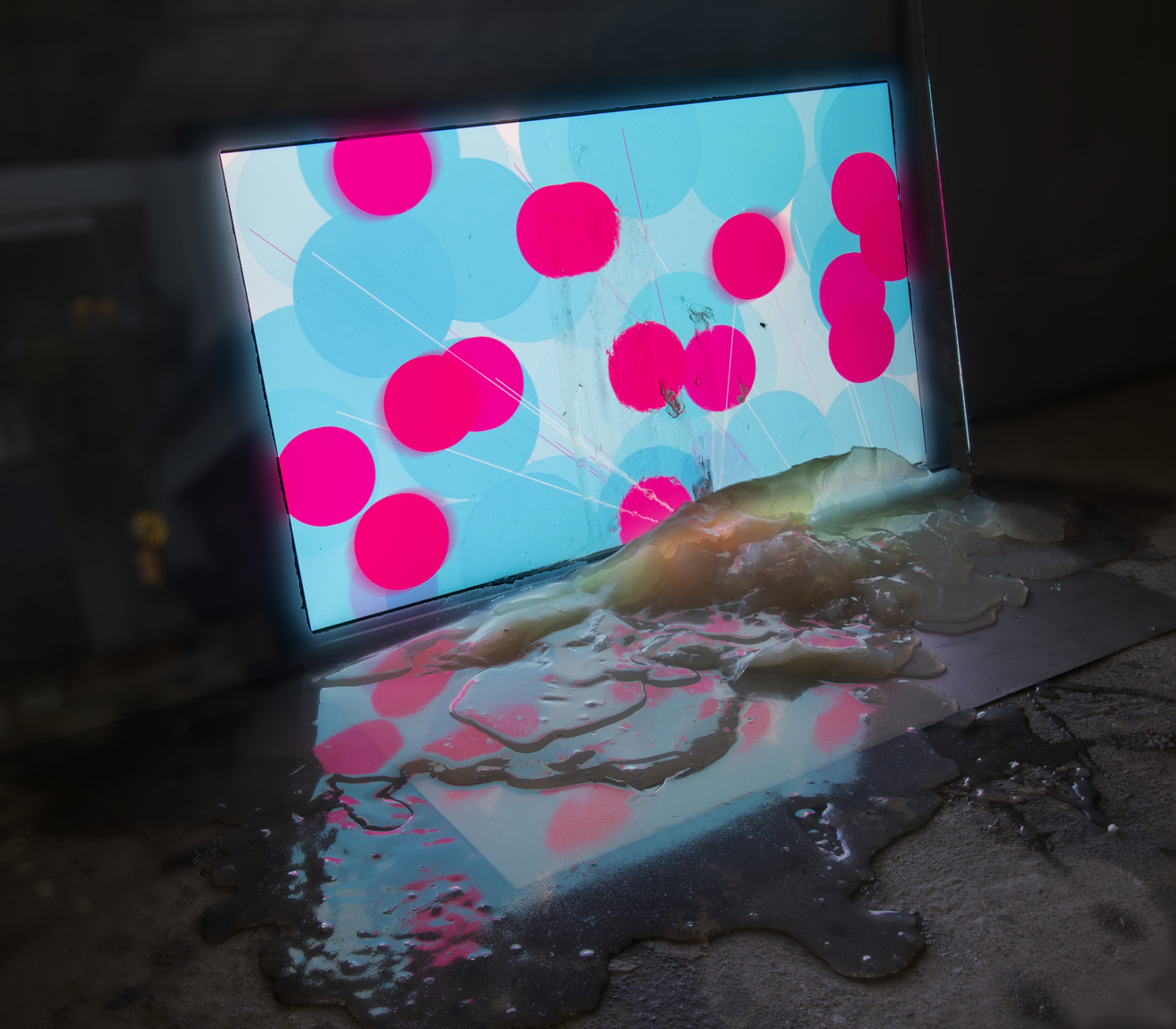
A brain–computer interface (BCI) was used to record my brainwave data as I watched Wippenbeck’s films. On a screen, generic visual representations generated from this data appeared. The data visualization and image-processing system was developed by Studio Fluffy.
The installation was presented in the courtyard of a former printing house (Projektraum mold).
Materials such as wire, concrete, agar-agar gel, objects collected from my hometown, and generative graphics based on my brain activity were incorporated into the work.
Together, these elements interconnect to form a spatial representation of the layered and ever-shifting structure of memory itself.
Some photos about the project ↓


2021
Ink and gouache on paper B4


The project memo.re is an art project by Chiharu Koda and was funded by BBK (NEUSTART for visual artists). It was realized in collaboration with Verena Wippenbeck (film) and Studio Fluffy (data visualization).
Zur Website des Projekts (auf Deutsch)
To the website of the project (in german)
甲田千晴
memo.re
2021